
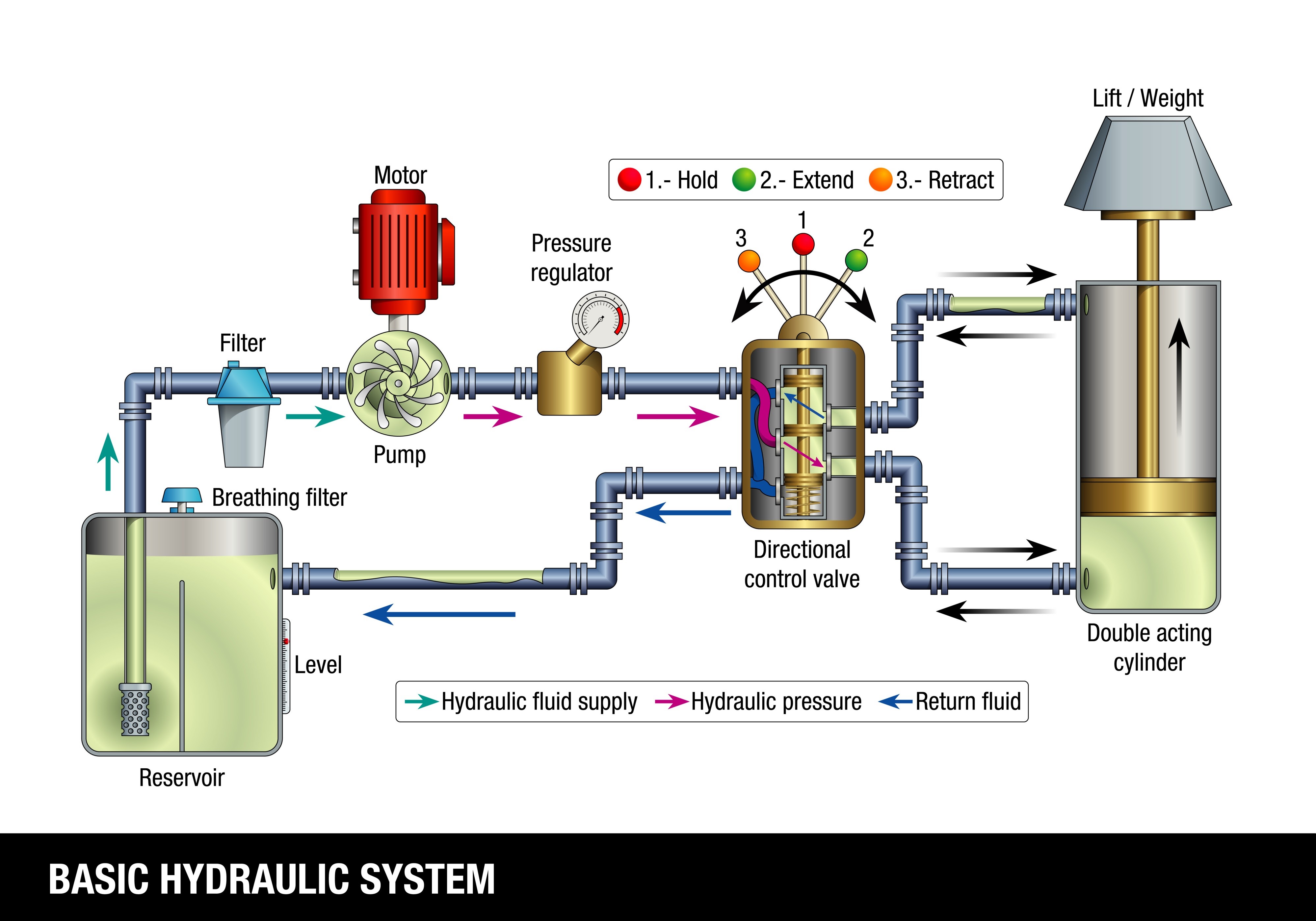
What Is a Hydraulic System?
A hydraulic system is a technology that uses liquid as a medium to transmit force and motion. In modern industrial applications, the liquid used is typically hydraulic oil, which is specifically designed to transfer power efficiently while lubricating and protecting system components.
The basic principle is straightforward: mechanical energy is converted into hydraulic pressure inside a sealed system. This pressure is then transmitted through the hydraulic fluid to produce mechanical motion with significantly greater force than the original input.
Pascal's Law: The Secret Behind Hydraulic Power
The remarkable strength of hydraulic systems is based on Pascal's Law, discovered by the French scientist Blaise Pascal.
Pascal's Law states:
"Pressure applied to a confined fluid is transmitted equally in all directions without any loss of pressure."
By applying this principle, a small force exerted on one piston can generate a much larger lifting force on another piston with a larger surface area. This is why an operator can control the massive arm of an excavator using only a small joystick inside the cabin.
Main Components of a Hydraulic System
A hydraulic system relies on several key components that work together to convert hydraulic pressure into useful mechanical motion.
1. Hydraulic Pump
The hydraulic pump converts mechanical energy into hydraulic energy by drawing and pressurizing hydraulic oil, supplying flow throughout the system.
2. Control Valve
Control valves regulate the direction, pressure, and flow rate of hydraulic fluid, allowing precise control of the system's operation.
3. Hydraulic Actuator (Cylinder or Hydraulic Motor)
Hydraulic actuators convert hydraulic pressure back into mechanical energy. Depending on the application, they produce either linear motion (hydraulic cylinders) or rotary motion (hydraulic motors).
4. Hydraulic Fluid (Hydraulic Oil)
Hydraulic oil serves as the power transmission medium while also providing lubrication, cooling, corrosion protection, and contamination control for system components.
Advantages of Hydraulic Systems
Hydraulic systems are widely used across industries because they offer several significant advantages over conventional mechanical or pneumatic systems.
High Power Capability
Hydraulic systems can generate extremely large forces, making them ideal for heavy-duty applications such as construction equipment, industrial presses, and lifting machinery.
Excellent Flexibility
Power can be transmitted efficiently through pipes and flexible hoses, allowing machines to operate in confined or hard-to-reach spaces.
Smooth and Precise Motion Control
Hydraulic systems provide accurate control over speed, direction, and force, making them suitable for applications requiring precision and stability.
Conclusion
Although the operating principle of a hydraulic system is relatively simple, its impact on modern industry is enormous. From automotive braking systems and construction equipment to manufacturing machinery and aerospace applications, hydraulics continues to serve as one of the most reliable and efficient technologies for transmitting power.
As industries continue to demand greater efficiency, precision, and reliability, hydraulic technology remains a fundamental solution that powers countless machines around the world.